Second Chances for Lonely Socks: A Beginner's Clinic in Visible Mending
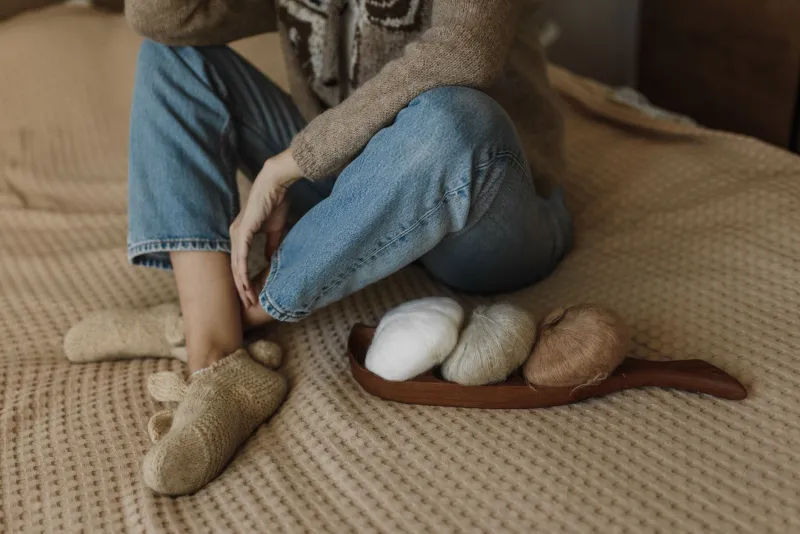
You know the drawer. Every house has one: the place where single socks go to think about what they have done. A stripes-and-no-partner situation. A trainer sock that survived a camping trip but lost its friend. A woolly one that has been waiting since February for a heel that never quite healed.
Rather than treat that drawer as a bin bag in waiting, we are going to treat it as a waiting room. Welcome to the sock clinic — a low-pressure, high-satisfaction way to learn hand sewing on the cheapest fabric you already own.
Why socks are the perfect first mending project
Socks are small, soft and entirely without drama. There is no pattern to cut, no fitting to worry about and no expectation that the finished thing will look shop-bought. If a mend goes sideways, you have lost nothing except a sock that had already lost its partner.
They are also the ideal place to practise visible mending — the lovely, slightly defiant idea that a repair should be seen rather than hidden. A bright darn on a navy heel is not a confession of sloppiness. It is a little badge of honour, and honestly a much better story than 'bought in a multipack'.
The kit: everything fits in a biscuit tin
You need almost nothing. A round tin that once held shortbread is the traditional vessel; a small freezer bag works just as well.
- A darning needle. Blunt tip, big eye. Tapestry needles are ideal and cheap as chips.
- A darning mushroom, or a stand-in. A smooth ball, an egg cup, a lightbulb (carefully) or a rolled-up pair of tights will all hold the heel taut.
- Thread. Leftover sock yarn, a bit of DK, or embroidery floss for decoration. Contrasting colours are the whole point.
- Small sharp snips. Fingernail scissors are fine.
- A needle threader — genuinely a game-changer for tired eyes.
- A couple of clips or safety pins to hold folds.
- A scrap of jersey, saved from a worn-out T-shirt.
Total outlay if you are starting from scratch: a tenner, maybe less. Everything in that list lives happily together for years.
Mend one: colour-block darning (the workhorse)
This is the technique for holes in heels and toes, and it is far easier than its reputation suggests.
- Triage. Clip away loose fluff and any thread that is waving about. Do not make the hole bigger, just tidy the edges.
- Stretch it out. Slide your mushroom or ball inside the sock so the hole sits flat and slightly taut across the top.
- Lay the warp. Working across the hole, sew a series of straight stitches from one solid edge to the other, about 3mm apart. Do not pull tight — let them lie flat.
- Weave the weft. Now work the other way, passing the needle over one warp thread and under the next, like a tiny woven basket. Alternate as you go so it locks together.
- Finish. Take the needle to the inside, tie off and trim.
Use a completely different colour and the mend becomes a woven square of joy. Use something close and it simply vanishes. Both are correct.
Mend two: the cheerful patch
For bigger holes, or a heel that has gone entirely see-through, a patch is your friend.
Cut a piece of jersey from an old T-shirt, a worn-out legging leg or a scrap of jersey bedding — something stretchy. Make it about 1cm bigger all round than the hole. Pin or clip it on the inside, then stitch around the edge with a simple running stitch, a backstitch for extra strength, or a blanket stitch if you fancy something neater. Pinking shears on the patch edge will keep it from fraying if the fabric is woven rather than stretchy.
A patch on the sole is best kept plain and flat so it does not rub. A patch on the ankle or the cuff is a licence to be silly: a bright circle, a heart, a stripe, a tiny flag.
Mend three: a little motif over a thin spot
Thin spots that have not yet become holes are the perfect excuse for decoration rather than repair. Stabilise the area with a few tiny stitches first if it feels fragile, then go to town:
- Sashiko-style crosses — little plus signs in rows, endlessly forgiving.
- A lazy daisy — five loops around a French knot.
- A single star — five straight stitches from a centre point.
- An initial — the wearer's letter, right on the toe.
Work motifs on the leg or cuff rather than the sole, and keep the thread fairly loose so the sock can still stretch when it goes on.
Turning it into a Saturday ritual
A clinic needs atmosphere. Clear the kitchen table, put the radio on, make a pot of tea and set out the patients in a little basket. Work through one at a time — about fifteen minutes per sock, so three or four is a satisfying afternoon's work.
It is a lovely thing to do with a friend, a teenager, or a child old enough to handle a needle with supervision. Give everyone their own mushroom and let the colours clash. Biscuits help. Biscuits always help.
Thread that survives the wash
Sock yarn (typically a wool and nylon blend) is the gold standard for anything on the heel or sole, and a surprising amount of it is spun in Yorkshire. Embroidery floss is beautiful for motifs but not strong enough for a heel that takes a daily pounding. Wash your finished mends at 30 degrees, inside out, in a mesh bag, and dry them flat rather than over a radiator.
When to say goodbye
Some socks are beyond the clinic. If the heel has gone entirely, the fabric is see-through across the whole sole, or the cuff elastic has given up the ghost, let it go — but not into the bin. Cut socks into cleaning cloths, use them for stuffing a draught excluder, or tie them around plant supports in the garden.
Everything else gets a second life, with the repair showing proudly. Which is rather the point: a sock with a story is better than a sock with nothing to say.